Robot vacuum leaving lines of dirt? Read the pattern, then fix the path
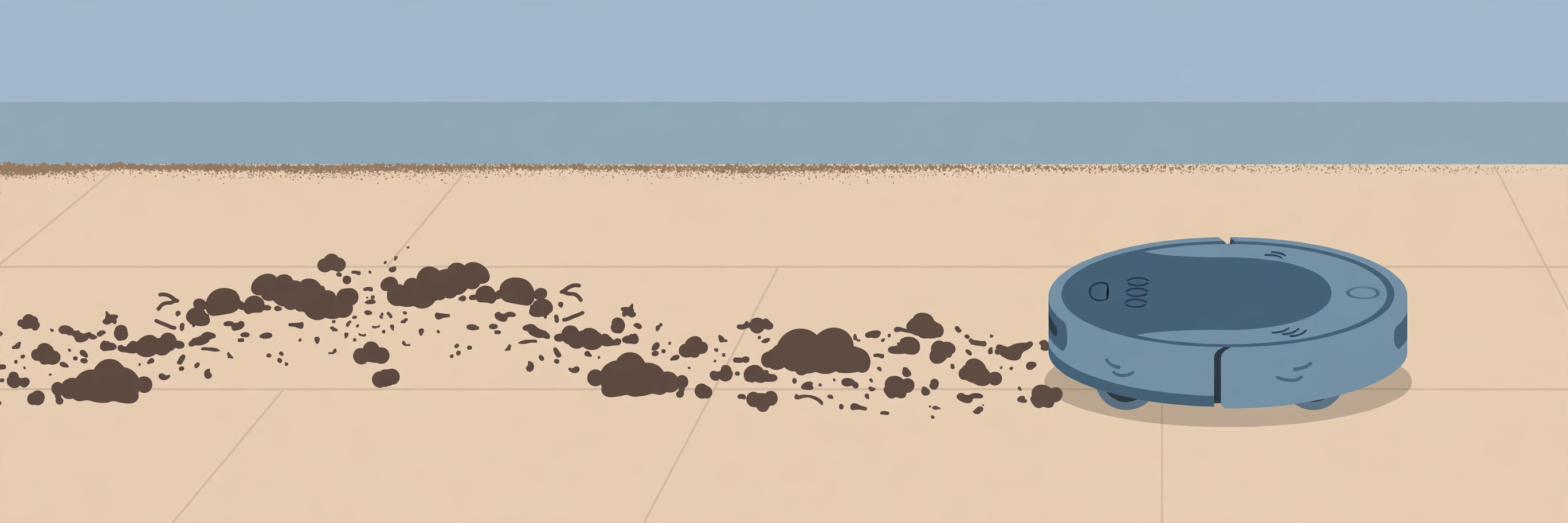
The clean finishes, the robot docks, and the floor tells on it: a trail of clumps across the living room, or a grey strip hugging every baseboard, or neat lines of grit exactly where the robot just drove. Owners tend to read all three as “losing suction” and start shopping for filters. But dirt left behind is a map, and where it sits names the subsystem that failed. Clumps dropped mid-room are a bin and air-path story. A strip along the walls is a side-brush and geometry story. Lines behind the robot are debris being carried and shed. Read the pattern first, fix only what it names, then prove the fix with a two-minute debris test instead of hoping the next full clean looks better.
Read the dirt first: three patterns, three subsystems
Clumps and tufts dropped in open floor. The robot picked this debris up and put it back down. iRobot’s support for the s9 names the mechanism directly: in homes with heavily shedding pets, the bin fills quickly with hair and the robot re-deposits it on the floor as it drives. Roborock’s S7 manual files the same symptom, poor cleaning, dust falling out, under three causes: the dustbin is full, the filter is blocked, or the main brush is jammed. All three live in the air path, and none of them is the motor.
A thin strip along walls and around corners, with clean open floor. Pickup in the middle of the room is fine; the edge system is not doing its half of the job. The side brush exists to sweep wall-line debris inward toward the suction inlet, and the inlet sits centered under a round body, which is why a small zone in sharp corners stays outside the suction stream even with healthy brushes. That last part is geometry, not failure, and no part replacement repeals it.
Fine lines or a faint trail behind the robot’s path. Debris is being collected and leaked in the same pass: an over-full bin shedding as it vibrates, a blocked filter choking airflow so material drops at the brush, or a brush scattering instead of feeding, a side brush spinning too fast can scatter dirt rather than sweep it in.
Pattern table: where the dirt is vs what failed
| Pattern | Subsystem | First fix |
|---|---|---|
| Clumps and hair tufts in open floor | Bin and air path, bin full, filter blocked, main brush jammed | Empty the bin, tap the filter clean, clear the brush and vacuum path |
| Strip along baseboards, open floor clean | Edge system, side brush worn, bent, or not sweeping; edges blocked | Inspect and clean the side brush; clear baseboard clutter; run an edge-focused pass |
| Dirt only in sharp corners | Geometry, round body, centered inlet | Accept and spot-clean corners; no part is broken |
| Lines shed behind the robot | Carry-and-leak, over-full bin or choked airflow | Bin and filter first; enable pause-when-full where offered |
| Whole rooms look untouched | Navigation, not pickup, dirty wall or cliff sensors can make a robot miss spots | Wipe the wall and cliff sensors with a soft dry cloth, then retest |
Fix the air path: bin, filter, extractors, vacuum path
- Empty the bin properly, and learn its full signal. On the s9, the light ring around the CLEAN button turns red, sweeps to the rear of the robot, and flashes twice when the bin needs emptying, and iRobot’s remedy for pet-heavy homes is a conditioning rhythm: schedule frequent cleans and empty the bin and clean the filter whenever the full-bin indicator shows. Where the app offers it, one setting ends re-depositing outright: Settings, then “Finish cleaning when bin is full,” pauses the job the moment the bin fills instead of letting the robot carry and shed the overflow.
- Tap the filter out. Remove the filter from the bin and shake debris off by tapping it against a trash container. Know your filter before water goes anywhere near it: the s9’s filter is not designed to be washed or to encounter liquid. The bin itself can be rinsed with warm water, and must be completely dry before it goes back.
- Clear the extractors and the vacuum path. Open the cleaning head module door, remove the brushes, and clear hair and debris from the square and hex pegs the brushes mount on, and from on and under their bearings. Then confirm the vacuum path itself is clear end to end, a wad lodged mid-path performs exactly like a dead motor, and it is the survivor most often missed.
- Give the settings a fair chance. Two passes help in pet homes and for deep cleaning: on Roomba models the pass behavior lives at Settings, Cleaning Preferences, Automatic, where automatic mode chooses two or more passes for a small room and one for a larger space. Pickup power lives in the same menu, the Custom option toggled fully right is the strongest pickup, bought with battery runtime.
Fix the edge: side brush, settings, and honest geometry
Start with the brush itself. Side brushes sweep debris from the wall line into the suction path, and they fail quietly, bent, flattened, or hair-wrapped bristles sweep nothing while looking almost normal. Narwal’s maintenance guidance is to clean side brushes weekly and replace them every two to three months, and its reasoning matches the symptom: with a bent side brush or a full bin, airflow and sweep both drop, and debris stays in the corners it was supposed to leave. Check also that the brush actually spins during a run, a brush that does not turn is a jam or a mounting problem, not wear.
Then give the edge a real chance to be cleaned. Edge mode exists because one standard pass is not always enough along walls: in edge mode the robot slows down, hugs the wall line more precisely, and makes multiple passes there. It does not change the robot’s physical reach, nothing software-side can, so schedule it as a dedicated weekly edge session on top of normal cleans rather than expecting every run to double as one. Clear the runway, too: cables, curtains, and low furniture parked along baseboards stop the brush making contact at all, and keeping roughly 5 to 10 cm of clearance along the baseboards lets the brush use its full sweep. What remains after all of that, the small triangular zone in a sharp 90-degree corner, is the honest limit of a round robot with a centered inlet. It is a thirty-second hand-vacuum job, and recognizing it as geometry instead of failure is what stops the parts shopping.
The two-line debris test
- Lay the test. On a hard floor, pour a short line of dry, visible debris, uncooked rice or coarse crumbs, along a baseboard, and a second line across open floor in the robot’s path.
- Run once. Send the robot through that room on its normal setting. Do not help it, and do not run a second pass.
- Read the lines separately. The open-floor line tests the air path: bin, filter, brush, suction. The baseboard line tests the edge system: side brush and wall following. Each line passes or fails on its own, and a split result, open line gone, wall line intact, is a complete diagnosis, not a partial clean.
- Fix, then retest the same lines. Work only the subsystem the failed line names, lay fresh lines in the same places, and run again. The test is the receipt: same debris, same spots, visibly different result.
What success looks like
Both test lines are gone in a single pass, the bin afterwards holds roughly what the lines contained, and a full clean leaves no clumps behind it and no fresh strip along the walls. The corner triangles may still hold a whisper of dust, that is the geometry limit, and it stays stable week to week instead of growing. A strip that keeps widening, or clumps that return with an empty bin and a clean filter, means the pattern has changed, re-read it from the table rather than repeating the last fix louder.
FAQ
Is this the same problem as losing suction?
They share causes, bin, filter, and air path, which is why the
isolation sequence in the suction guide pairs well with this one. The
difference is the evidence: weak suction shows as debris left in place,
while these patterns show debris moved, carried, or never reached.
Will a stronger suction setting fix the wall strip?
No. The strip survives because debris at the wall never enters the
suction path, the side brush’s sweep is what feeds it there. Power
helps the open-floor line of the test; the wall line answers to the
brush, edge mode, and clearance.
How fast should clumping clear in a pet home?
iRobot frames it as conditioning rather than a single fix: frequent
scheduled cleans, bin emptied at the full signal every time, until the
backlog of hair in the home is worked down and the bin stops filling
mid-run. The debris test tells you whether the robot’s side of the
bargain is already fixed.
Next: losing suction? Isolate the filter, bin, seal, and air path →