Robot vacuum mop not wetting the floor? Trace the water path from tank to pad
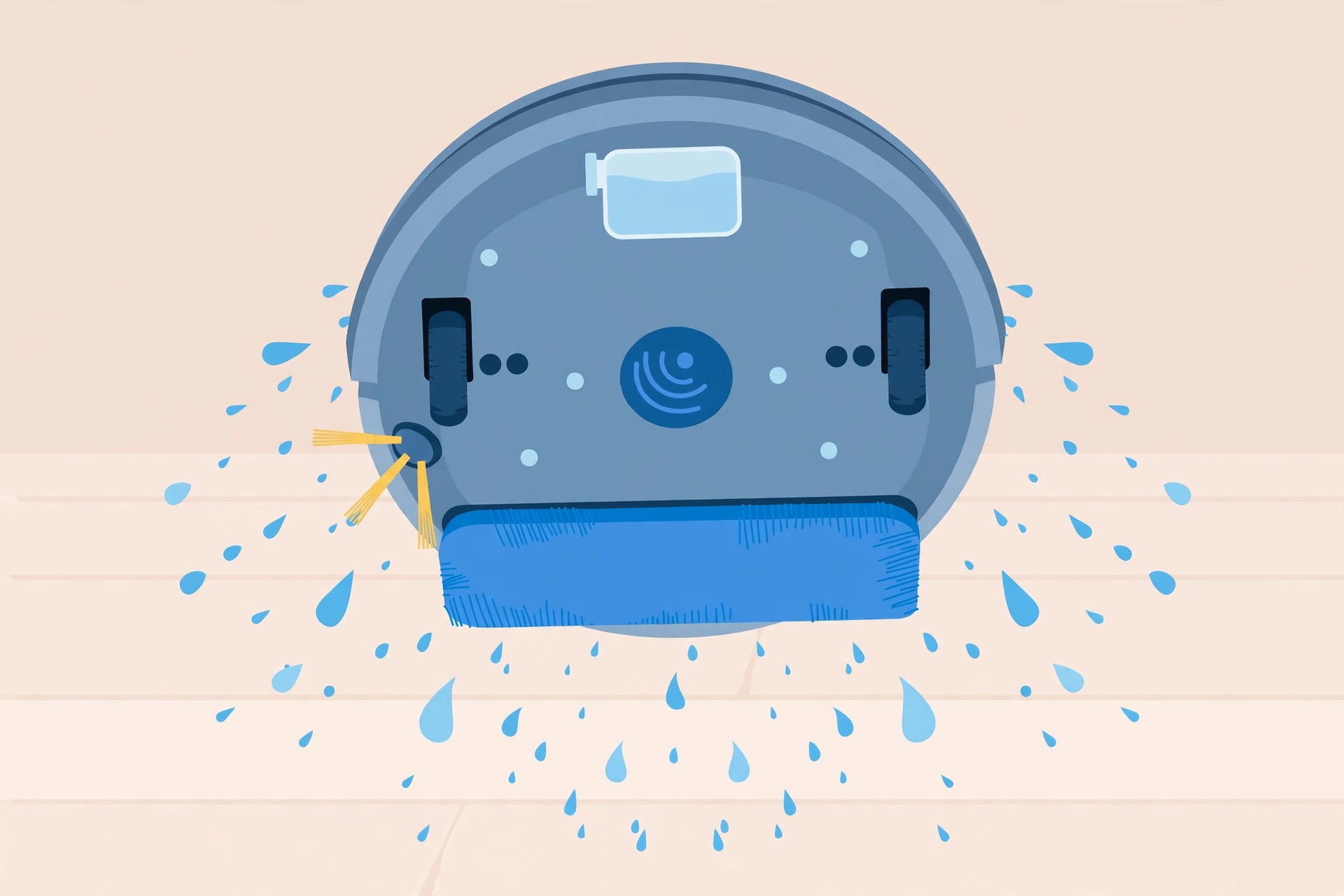
The robot announces a mopping run, drags its pad around the kitchen, and leaves the floor exactly as dry as it found it, or wetter in streaks than in coverage. Owners tend to blame the pump, because the pump is the part they cannot see. In practice the failure lives in one of three places, and only one of them is the pump: water is not leaving the tank, water is leaving the tank but not reaching the floor evenly, or the pad can no longer hold and release water like it should. The manuals reduce this to two lines, for a mop that is not dispensing, check for an empty tank or a clogged nozzle, which is accurate and almost useless, because it never tells you how to find out which one you have. The bench test below does, in about five minutes.
Read the floor first: three symptoms, three systems
Pad bone dry after a full run, tank still full. Water never moved. The suspects are the tank seating, the outlet or nozzle, and the flow setting, in that order.
Pad damp at the start, dry within minutes, tank level barely drops. Water starts and stops. That pattern points at a partly blocked outlet or a tank that is not seated well enough to feed steadily.
Pad wet, floor streaky. Water is flowing; the cleaning is failing. Now the pad’s condition, what is in the water, and what was on the floor before the mop arrived are the system to fix, not the water path.
Symptom table: what you see vs what failed
| Observation | Most likely point of failure | First fix |
|---|---|---|
| Pad dry, tank full after a run | Tank not seated, outlet/nozzle blocked, or flow set to off/lowest | Reseat the tank and combo unit; inspect and clear the outlet; raise the app flow level |
| Pad wets, then dries mid-run | Partial blockage or poor tank feed | Remove the tank, check its outlet and the robot’s inlet for debris or scale, reseat firmly |
| Pad wet only in the middle | Pad not fully attached, or pad mount warped/misaligned | Reattach the pad across the whole mount; confirm the mount itself sits flat |
| Even wet trail, visible streaks | Dirty or worn pad, wrong solution, unswept floor | Fresh pad, water or manufacturer solution only, dry-vacuum pass first |
| Pad will not stay wet even off the robot | Pad material spent, heat or softener damage | Replace the pad; change the wash routine (below) |
The bench test: isolate the water path in five minutes
- Fill and weigh in. Fill the tank fully, note the level against the tank’s own markings, and seat it until it clicks or sits flush. On combo units, confirm the dustbin/water-tank unit, the mop mount, and the pad are all installed the way the manual shows, a slightly unseated combo unit is a classic silent cause of a dry pad.
- Pre-wet the pad. Run the pad under a tap, wring it so it is evenly damp, and attach it across the full mount. A pre-wetted pad removes the slow first minutes from the test and proves the pad can still absorb: a pad that sheds water off its surface instead of soaking it in has already failed, whatever the tank does.
- Set the flow up. In the app, raise the water flow to a high level for the test. Electronic tanks offer several flow levels precisely so flow can be matched to the floor, and a low or off setting is indistinguishable from a blockage until you change it.
- Run short, on a dark hard floor. Two to three minutes in one room is enough. Water shows clearly against dark tile or laminate, and a short run keeps the tank-level change readable.
- Read the three stops. Tank level dropped and pad evenly wet: the path works, the original problem was the setting or the seating. Tank level unchanged and pad dry beyond its pre-wet: water is not leaving the tank, inspect the tank outlet and the corresponding inlet on the robot for debris, a displaced seal, or visible scale, and clear what you find. Tank level dropped but the pad is patchy: the mount or the pad is the fault, not the delivery.
Fixing the streaks, once water is flowing
A wet pad that still streaks is usually pushing dirt around rather than lifting it. Vacuum first, a dry pass before the wet pass, because dust and grit left on the floor turn into mud under a mop. Start each cycle with a fresh pad, and swap pads partway through a long session instead of letting one loaded pad redistribute grime across every room. Fill with clean water or the manufacturer’s recommended solution at the recommended amount: shop-bought floor cleaners can be too harsh for the robot’s internals, can damage floors, and leave exactly the residue film that reads as streaking. If a first pass leaves marks, a second plain-water pass lifts most of what remains.
A note on integrated tanks and wash docks
Not every mop draws from a removable tank you can lift out and inspect. On models with an electronic tank integrated into the robot, the outlet checks above happen at the tank’s fill cap and the dispensing points on the underside instead, the bench test still applies unchanged, because the question it answers (did the level drop, did the pad wet evenly?) does not depend on the tank’s shape. Those electronic tanks are also the designs with several app flow levels, so the setting check matters more, not less. On wash-dock models, add one check: the dock can only rinse a pad properly if its own clean-water side is filled and its dirty side emptied, a pad returned “washed” by a dock with an empty clean tank starts the next run as dirty as it finished the last one, and streaks get blamed on the robot.
Pad care that keeps water moving
Pads fail quietly. Wash reusable pads without fabric softener, which coats the fibres, and air-dry them only: high dryer heat and dryer sheets damage a pad’s water retention, after which it can neither hold water nor release it evenly, the pad looks fine and performs like plastic. A disposable single-use pad is done after one session by design. When a clean, correctly washed pad still will not absorb under a tap, it is spent; replace it before suspecting anything inside the robot.
What success looks like
On the bench test’s short run, the tank level visibly drops, the pad is evenly damp edge to edge, and the dark floor shows a continuous wet trail with no dry lane down the middle. Across a full clean, the trail stays consistent from the first room to the last, and the floor dries without visible streak lines. If water still will not leave a full, correctly seated tank with a clear outlet and the flow set high, the delivery mechanism inside the robot is the remaining suspect, that is a support or service conversation, not a parts guess.
FAQ
Can cleaning solution go in the tank?
Only the solution your manufacturer recommends, at the amount it
specifies. Other cleaners risk the internal mechanisms and the floor
finish, and their residue is a streak cause in itself.
The pad gets wet but the floor looks dirtier. Why?
The pad is moving soil, not removing it: vacuum first, start with a fresh
pad, and swap pads during long runs.
Is a pump failure common?
It is the last thing to conclude, not the first. Tank seating, the
outlet, the flow setting, and the pad each fail more quietly and are all
testable in minutes with the bench test above.
Next: losing suction? Isolate the filter, bin, seal, and air path →